

Wood Magic
2010-2016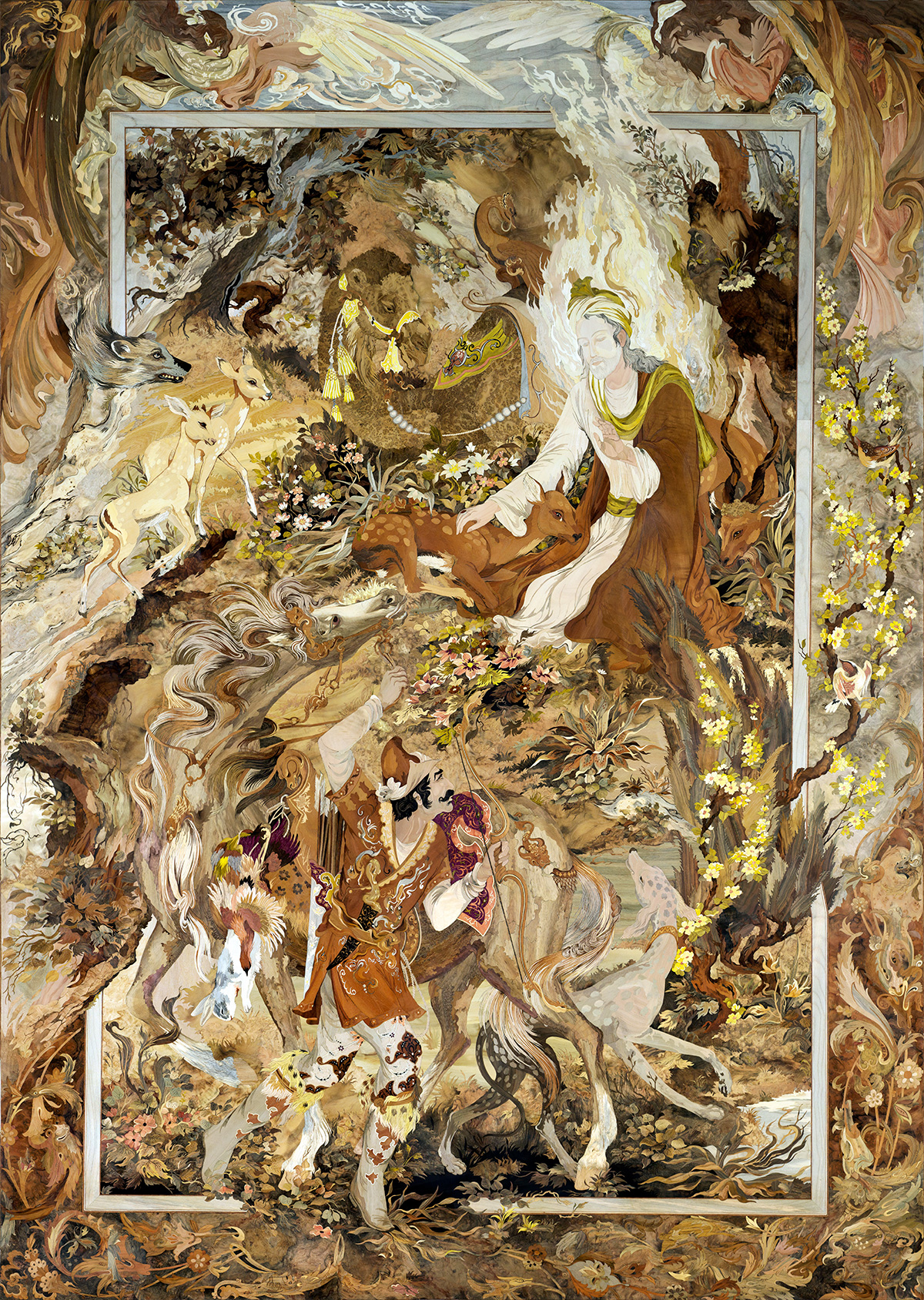
The motivation behind the work
In the year 2009, there happened a revolution in my mind and thoughts. Before that, I had already been familiar with the art of moarragh and had experienced it and attained some skills. That was the moment I thought I should devote my time and energy to create a more enduring piece of art; a unique work to be an example of posterity.
This idea occupied my mind for a few weeks. I finally decided to listen to my heart and pursue the idea seriously.
 – The holy shrine of Imam Reza (PBUH), the eighth imam of the Shi’a, Mashhad, Iran
Trees and woods are sacred in many religions and have positive effects on humans’ conscience; therefore, I searched for a theme and a subject, which harmonically match with this specific feature of them, so that the theme and wood can enhance their spiritual effects in a homogeneous composition.
It might have been the consequence of being a neighbor of Imam Reza or it was the God’s grace upon me that led me to think of selecting a theme and subject related to Imam Reza. To me, it was both work and love. For years, the precious painting of Master Mahmoud Farshchian, named “the guarantor of the gazelle”, impressed me. I honestly believe this is an impressive and outstanding work of art in the history of miniature painting. I could not find a better subject than this exquisite work of Master Mahmoud Farshchian; it was simply the best. This elegant painted work with its spiritual context could most appropriately entangle with the pacific nature of work and leave an increased impression.
 – Part of “The Guarantor of the Gazelle” by Mahmud Farshchian
Discovering a new method
Although I had learned many skills in conventional methods of moarragh for years, I found that none of them would help me do what I had in mind.
Commonly, one of the many problems which moarragh artists have to cope with is the gaps and slits that are created when wood particles are put next to one another. These gaps and slits are the result of errors in the designing pattern as well as the cutting process and are inevitable. Generally, putty is being used to solve this problem and to prevent bad view of the wood. Regardless of other issues of conventional methods, which are highly technical and beyond the purpose of this writing, I finally concluded that the level of precision, elegance and quality that I had in my mind can never be achieved using these methods. This made me to decide to find (or invent) a more accurate method of my own to do the moarragh work. For some months, I reviewed and examined various methods, all in vain. Once in a very vague time, an idea came to my mind. I went to my workshop quickly and tested it. To my astonishment and pleasure, I saw that my method works out very well. I tested it again and again in different situations. That was it. A new method was invented which seemed to meet my concerns in the work pretty well.
 – Demonstration of a few techniques used in the artwork
I was extremely happy. I thanked God and something deep inside me triggered this was Imam Reza’s gift and grace for me.
It must be pointed out that this innovation was in fact the preliminary method of this specific moarragh work which gradually evolved during the work.
During the years of doing this work of art, even using this innovative method had its own technical complexities and obstacles which in turn led to modifications and developments of the method and finally turned it to a very fast, efficient, flexible and accurate method.
Wood particles from all around Iran
Method was not all that I was concerned about. The more important thing was finding the right pieces of wood. Diversity, color and the quantity of the woods which I had were restricted and insufficient for this moarragh work. I believe the attraction and beauty of moarragh is highly dependent on the colors of the woods. In this work of art, I really wanted to exhibit the indescribable beauty which God has granted to trees in the form of magical themes and colors. Delicate themes which are filled with energy and senses all over the woods and human often pass them by indifferently.
 -Hezar Masjid heights, Kalat-e Naderi, Iran
There were specific market places for selling moarragh wood particles, which I used to go every month to buy woods. However, in those market places, only some common woods were offered and the diversity of the woods hardly reached 50 different types of woods. I had to study more about trees and woods. During my investigations on this issue I came up with a book titled “Forests, trees and Bushes of Iran” written by Dr. Habibollah Sabeti. This book provided me with rich information of different types of plants in Iran and convinced me to start travelling around the country to collect them.
A chainsaw, me and the road …
Based on the book guidelines, some species were more likely to be found in the north of Zagros mountains in the area of Sanandaj and Uramanat, some in the central and southern parts of Zagros, yet others in the north of Alborz mountains or the southern parts of them. Some species were uniquely found in Arasbaran forests in the northeast of Iran while some other were only found in Hezar Masjed mountains. Also the central desert of Iran was the habitat of some desert plants such as tamarix, Haloxylon (saxaul) and Arecaceae (palm trees) while Baluchestan and Kerman provinces in southeast were the habitat of unique plants such as Prosopis, Capparis decidua (karira), papaya, etc. From the southern cities of Bandarabbas, Minab, Qeshm, Khor-e Azini, Jask, and Jiroft to Shiraz, Yasuj, Izeh in the southwest; from Fandoqlu forest and Talesh in the northeast to Mazandaran, Gorgan and Bojnord in the north of Iran; I traveled to all these places and natural habitats to find different types of wood in person. In each region, I talked with local people about the local trees and in some cases I collected interesting information about them. One of my mostly asked questions was about the local name of each specific tree or type of plant. Interestingly, some of these trees had different names in different areas.
 -Woodcutting a dried mango tree, Minab, Iran
Since the theme and the color of each type of tree might vary from one area to another, I tried to collect several samples of each type in every region. During the six years of creating my moarragh work, I travelled to almost every region in Iran, which resulted in collecting the best wood colors and themes of several thousands of trees around the country and even some other parts of the world outside Iran.
Samples of more than 150 different types of trees
Sometimes, I needed to travel to the Persian Gulf coast to find a very rare sample of loop-root mangrove tree and sometimes I had to buy a wooden statue made of Diospyros ebenum (Ceylon ebony), and use its wood in my moarragh work.
For some specific themes of wood, I had to search more than two years in hundreds of types of woods and trees. In some cases, however, I came up with a unique theme or color of wood which I had not seen ever before.
One thing is certain: finding such diversity of woods’ themes and colors was not an easy job at all; however, the effort turned this moarragh work into a treasure of different types of trees and shrubs of Iran.
A valuable profile package of Iranian trees has been worked upon in the heart of a work of art which is unique in terms of the diversity of the particles used. A notable point here is that, although I needed to use woods of trees for my work, I did not harm a single tree during my quest around the country. All the woods have been collected from dead trees or from a part of tree which did not harm the tree at all. This work was spiritually important to me and I did not want to take the life of a living creature to finish my job!
The starting point
The first particle was successfully cut on Sunday, June 28th, 2009. A direct start which I did not care about its end.
 – The workshop where the artwork formed
The only important issue for me was the quality of the work. However, I had two major challenges. First, the color range of woods were more limited as compared to chemical colors. In this sense the palette of colors of moarragh works is originally driven from nature and the trees while in painting the colors are simply created by mixing. Thus the harmony of colors was solely created out of the moarragh artist’s personal intuitive understanding of the available colors of woods. Second, since the texture of the wood is an inseparable component, managing it and the themes or motifs on the wood and their double effect of improving or degrading the elements of the work, added to the complexities of the whole work.
It was also difficult to find an appropriate texture alongside with the ideal color in one single wood particle.
Sometimes, making a part of the work with the size of one hand, would take one week or more. All in all, more than half of the workshop time was spent on thinking on the details of the work; Details such as calculating and measuring the different dimensions and sizes of the particles and the elements of the work, matching them and even trying to comprehend the language of the woods.
During working time, many questions were repeated over and over in my head and I had to spend many hours and days to find their answers. For example:
What particle with what kind of color combination should be formed in a fashion which solely can be the most beautiful and the most impressive and at the same time can be in harmony with the surrounding particles and the whole work?
How can the limited range of wood colors be mixed so that the particles are not lost in the background of the work?
What feelings can the colors and textures create in the eye of the audience?
What parts should be more eye-catching and what other parts should be hollowly hidden and what types of wood should be used to make this combination?
And …

It happened a lot that I could not find a proper wood particle for a specific part and leave it till I find appropriate particle. In total, nearly 80,000 pieces of wood with natural color were integrated into the work and created my moarragh work of art. All the stages were executed using not only the conventional methods but also my own innovated methods.
While making different elements of the work such as gazelles, shrubs, birds, etc my holistic approach was on achieving more elegance, certainly with an emphasis on respecting the trusteeship about the original painting.
My aim was to delicately put each and every magical theme of the woods at its most appropriate place where they match harmonically with surrounding elements and create a more impressive visual effect on the eye of the audience. I did not care about whatever method I used; whether they were the method of distinction of colors, traditional method or mixing themes. My principle was illustration of the highest achievable beauty. In some cases, one single piece of moarragh was best executed by traditional method, while in some other case it was best to use the method of distinction of colors or in yet another case substitution or mixing themes would have been the best way to achieve more beauty in the work. And even in some other cases, a customized combination of all these three methods in one element.
More information has been provided in the section of “the details”.

In making the pieces, I tried to use one type of wood to build each separate item. For instance, for making the texture of skin, with all its penumbra and lightings, pear wood has been used. Or as for the gazelle horn, Kahoor (Prosopis cineraria) wood has been used because it is more compact, hard and compressed, and its color matches the item of horn very appropriately.
This high degree of emphasis was for more accuracy and precision in beauty and harmony between colors and textures because using different types of wood with different types of textures in one part which is suitably homogenized, would decrease the beauty and integration of the whole work and leave negative visual effect on the eyes of the audience. Of course, this emphasis would cause many difficulties especially in that finding different texture and color tones in one single type of tree is very time-consuming and in some cases would take some years to be accomplished.

After 5 years of direct work on the moarragh, all the major parts were built. After being processed, all the elements were pressed to stick together by using water-based wood glue. After that the background and the negative environment of the work needed to be handled to finish the job. This part was the best place to play with different types of themes and textures of woods and to mix them to create space. I concentrated to balance negative and positive space without attenuating the main elements while illustrating different forms and states of wood in the background.
The needed level of accuracy for matching the curvy and complex lines and themes of woods with the ones in the whole generality of the work, took me one year to finish this part.
For the very special approach I had chosen toward the element of wood, the art of moarragh and personification of wood, I named it as “the magic of wood”. Finally it was finished on Friday, January 1st, 2016 after 6 years of constant effort and definitely [I believe] with the grace of Imam Reza. I did my best to create a work in his dignity.
Strengthening the work
In order to place the work on an enduring and durable framework, to conserve the work against humidity in the coming years, to prevent any expansion or contraction as a result of heat or cold, to avoid any unwanted and unforeseen fractions, and to make the whole work as light as can be easily moved, a wooden net-like framework which was made up of firs (abies) tree and had been pressed with 6-layer sheets from both sides was used.
Also the surface of the underlying sheet was covered with killer finishing color in order to secure it against humidity even more.

Generally, after a specific period of time, wood works would have a chemical reaction with air. It results in oxidation and color change which necessitate applying covering materials to extend durability of the work and protect wood against environmental conditions. To achieve this, most of the artists use mixtures of killer finishing colors, polyester, polyurethane, or other chemical compounds. Unfortunately, after a while all of these will have chemical reaction with wood and affect the natural color of wood. These coverings would degrade and even ruin the natural beauty and feeling of the wood and make it a little bit artificial. To prevent all these bugs, and after spending some time of researching and investigating, natural lacquer was used to varnish the surface of the work.
Lac is the scarlet resinous secretion of a number of species of lac insects, of which the most commonly cultivated species is Kerria lacca. This transparent material is usable after being processed and solved in alcohol. It is totally natural and has shown no chemical side effect. Also the covering it provides has no artificial effect but, quite contrarily, makes the whole work look even more natural. Considering high costs, too much time and the level of skill and expertise, it is not usually economic to use such covering and it is just used rarely for highly expensive exquisite works of art.
Meeting Master Mahmoud Farshchian
On Saturday May 14th, 2016, I found the precious chance to meet Master Mahmoud Farshchian in Sa’adabad Museum in Tehran while my work was exhibited there for a short period of time. His sincere admiration and support inspired me a lot and I was totally honored and got more decisive than before to continue my artistic path. He also gave me a valuable compliment manuscript as a gift which means a lot to me.

Unveiling
Because of some certain cultural and touristic features, Mashhad has been chosen by The Islamic Educational, Scientific and Cultural Organization (ISESCO) as the cultural capital of the Islamic world for the year 2017. Art experts and artists were looking to display a distinguished and sumptuous work of art during the opening ceremony of the event in which cultural ministers and delegations of 52 islmic countries were to attend; an exquisite work which can expose the rich cultural and artistic features of the Iranian civilization. The moarragh work of “the magic of the wood” was honored to be unveiled by ISESCO president as the elected representation of the culture and art of this ancient land.